

ARTICLE / "Conservation actions done on the population of Vertigo Moulinsiana and Vertigo Angustior (Gastropoda, Pulmonata, Vertiginidae) in the natural protected area of the Lake of Banyoles"


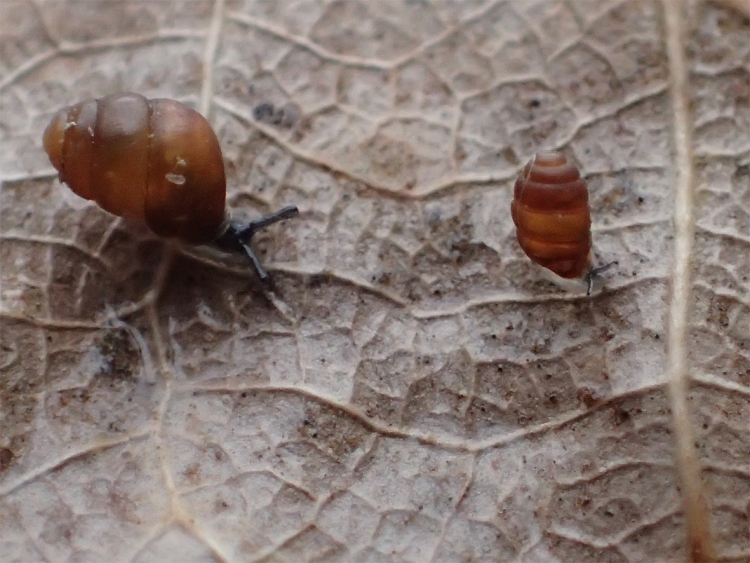
Vertigo moulinsiana and Vertigo angustior are two species of Gender Vertigo present in the Iberian Peninsula, set out in Annex II to Directive 92/43/EEC of 21 May 1992 on the conservation of natural habitats and of wild fauna and flora, known as "Habitats Directive". Both species are also included in the List of Wild Species under Special Protection (LESRPE) of Spain (RD 139/2011). Specific requirements for the hydro geological conditions they need and microhabitats occupied, are rigorous and different for both species. Both species are very sensitive to changes in water drainage and disturbance and fragmentation of habitat, these being the main causes of the significant decline in their populations in recent decades, which has led to its protection under Annex II of the Habitats Directive and the Red Book of Invertebrates of Spain (VERDU & Gallant, 2009).
Currently, the Banyoles Lake Protected Natural Area hosts a whole the best known of the population centers and V.moulinsiana V.angustior species of the Iberian Peninsula. In 2010 it carried out a first study aimed at achieving a basic knowledge of these shellfish in the vicinity of Banyoles Lake. Although preliminary data point to the existence of local good densities of V. moulinsiana and V. angustior somewhat lower for its extreme location and the current fragmentation of their populations suggest that they are in a process of general regression in this environment. It is therefore bound to expand the knowledge we have of its distribution, biology and behaviour on Banyoles Lake, developing an important work of prospecting and follow-up over time, allowing the adoption of appropriate management measures to ensure the viability and stability of these populations in the future. In this regard, in 2014 the "Conservation of river fauna of Community interest in the Natura 2000 network sites of the Ter, Fluvià and Muga river basins" [Potamo Fauna LIFE (LIFE12 NAT/ES/001091) (http://www.lifepotamofauna.org)], which aims to improve the populations of endangered species of European interest within a set of Natura 2000 sites basins of Ter, Fluvià and Muga rivers, view the need for implementation of the Habitats Directive and the Birds Directive, being V. angustior and V. moulinsiana direct objective of this project. The specific objective defined in the project LIFE Potamo Fauna regarding species V. angustior and V. moulinsiana is the expansion and consolidation of their populations in space Natura 2000 Banyoles Lake (ES5120008) by translocations of individuals living within the site. Among the actions to be developed within this project, and so prior to the completion of the translocations, the conservation status of the populations of both species in the lake environment will be defined. For this, the area of occupancy will be determined and the habitat occupied by each species will be characterized. Subsequently, the areas where the largest populations from which will be held to different translocations to Mediterranean temporary wetlands and lagoons will be verified. 1.-Els Amaradors, 2.-Can Morgat I, 3.-Can Morgat II, 4.-Finca de Casa Nostra, 5.-Laguna del Pim-Pom.
The actions of conservation related to the two species of Vertigo try to apply techniques not experienced with these species uo to now. The translocation of individuals to create new breeding populations is a widely used in conservation of endangered species and the results will allow to demonstrate the usefulness of such techniques. No conservation actions related to Vertigo in the Iberian Peninsula have been done yet, so the experience is pioneer. Other actions include a demonstration project and development of protocols and methodologies to monitor populations of Vertigo, since there are as yet standardized methodology for monitoring natural populations in the Iberian Peninsula, which constitute a document of great interest to define the guidelines to be followed in future work of monitoring and management of these two species of Community interest.
For both V. angustior and V. moulinsiana this project will be the first major project of conservation and management developed in the Iberian Peninsula, and will consolidate some of the populations that live in better condition, providing quality representation of both species in Europe.
Authors:
Mª JOSÉ MADEIRA. Doctor of Biological Sciences, Researcher.
BENJAMÍN J. GÓMEZ-MOLINER. Professor of Zoology. Associate Professor of the UPV/EHU
MIQUEL CAMPOS. Technical Coordinator of the CES. Financial Coordinator of the LIFE Potamo Fauna.